Antenna TV Channels by Zip Code: Free Over-the-Air Lists
A zip code channel list looks confident, but it is still an estimate, and the DTV reception map (federal regulator’s official tool) shows why: it assumes an outdoor antenna 30 ft above ground, which is one reason living-room results can differ from a printed list. The number on your screen also is not always the frequency a station uses.
Local channel cost: Free with an antenna (The Keen Guide (independent antenna buying guide)) ·
Reception estimate tool: FCC DTV reception maps (FCC DTV reception map, federal regulator’s official tool) ·
Assumed outdoor antenna height: 30 ft (FCC DTV reception map, federal regulator’s official tool) ·
Antenna bands: VHF channels 2-13, UHF channels 14-36 (FCC antenna guide (federal regulator’s consumer guidance)) ·
Spectrum lineup caveat: not all channels may be available in all areas (Spectrum support page (cable provider’s official lineup help))
Quick snapshot
- The DTV reception map estimates which stations are available at a location, using a terrain-sensitive model (FCC DTV reception map, federal regulator’s official tool)
- Spectrum lineups are tailored to a ZIP code, and not all channels may be available in all areas (Spectrum support page, cable provider’s official lineup help)
- Hilly areas may see significantly lower signal strength (FCC DTV reception map, federal regulator’s official tool)
- Which Spectrum channel number carries Antenna TV in any given ZIP code. The research behind this piece retrieved no lineup contents for a specific ZIP, only the page’s ZIP-based structure (Spectrum support page, cable provider’s official lineup help)
- Whether Antenna TV appears on a specific Spectrum lineup in a specific ZIP code (Spectrum support page, cable provider’s official lineup help)
- What a California ZIP code list shows, since no California listing was verified (no source retrieved for this gap)
- Almost all stations moving off UHF channels 38-51 finished transitioning in 2020-07 (FCC antenna guide, federal regulator’s consumer guidance) (FCC rescan guidance (federal regulator’s consumer advice))
- The FCC’s rescan guidance page carries a publication date of (FCC rescan guidance (federal regulator’s consumer advice))
- The FCC recommends rescanning TVs periodically to receive the current lineup for the area (FCC rescan guidance, federal regulator’s consumer advice)
- Stations may change frequency while keeping the same channel number, so a rescan is the fix (FCC DTV reception map, federal regulator’s official tool)
Ten figures do most of the work here, and most of them trace back to federal sources rather than to channel-listing sites.
| Item | Verified value |
|---|---|
| Cost of local over-the-air channels | Free with an antenna (The Keen Guide, independent antenna buying guide) |
| Official reception estimate tool | FCC DTV reception maps (FCC DTV reception map, federal regulator’s official tool) |
| Reception condition | Signal strength may vary with building construction, neighboring buildings and trees, weather, and reception hardware (FCC DTV reception map, federal regulator’s official tool) |
| Hilly terrain | Signal strength may be significantly lower (FCC DTV reception map, federal regulator’s official tool) |
| ZIP-only precision | Results may be less precise than an exact address (The Keen Guide, independent antenna buying guide) |
| Map territory coverage | Covers stations in states and territories, including Puerto Rico and the US Virgin Islands (Pocket-lint (consumer technology publication)) |
| UHF 38-51 station transitions | Almost all affected stations finished in 2020-07 (FCC antenna guide, federal regulator’s consumer guidance) |
| Spectrum lineup caveat | All channels may not be available in all areas (Spectrum support page, cable provider’s official lineup help) |
| Cable or satellite rescan requirement | Not required; the provider updates local channels (FCC rescan guidance, federal regulator’s consumer advice) |
| FCC rescan guidance date | (FCC rescan guidance, federal regulator’s consumer advice) |
Which free antenna TV channels can I get by zip code?
Free over-the-air stations are what a zip code lookup is really trying to predict. An antenna pulls in broadcast signals, not cable-only networks, so the list is a list of local stations. The Keen Guide puts the line plainly: an antenna receives free over-the-air broadcasts and does not receive cable-only channels such as ESPN, CNN or TNT (The Keen Guide, independent antenna buying guide).
Two homes in the same neighborhood can receive different antenna channels (The Keen Guide, independent antenna buying guide).
How zip code channel locators estimate reception
- A ZIP-only result may be less precise than an exact address, because reception varies within a ZIP code (The Keen Guide, independent antenna buying guide).
- A reception map predicts which stations may be available, while a channel scan shows what your TV can actually receive with its current antenna and placement (The Keen Guide, independent antenna buying guide).
Why local channels are free with an HD antenna
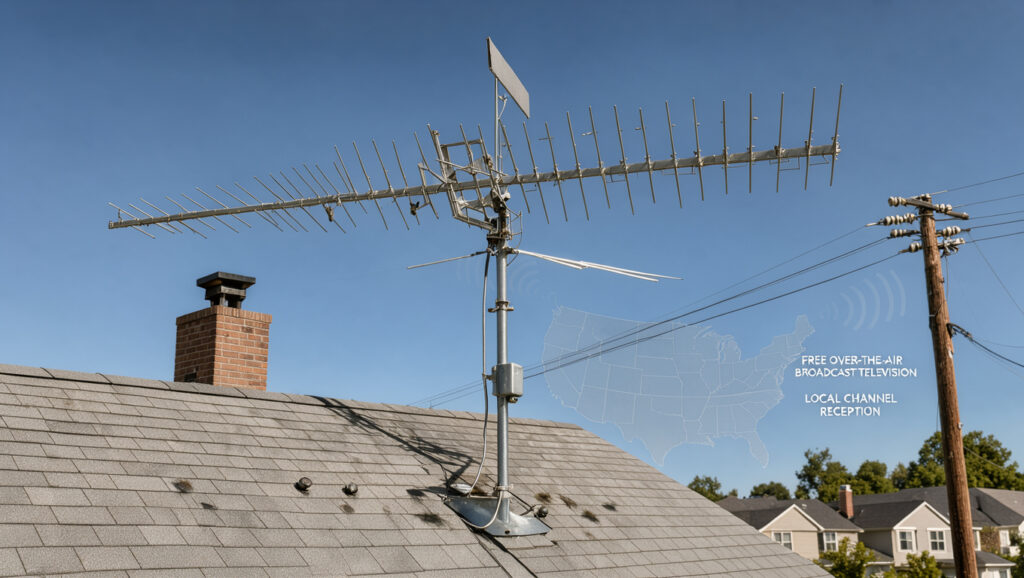
- To receive DTV signals from all stations in an area, an antenna must receive both VHF channels (2-13) and UHF channels (14-36) (FCC antenna guide, federal regulator’s consumer guidance).
- Outdoor antennas generally get better reception than indoor antennas, and the FCC strongly recommends them for the most reliable reception (FCC antenna guide, federal regulator’s consumer guidance).
A zip code list tells you which stations are nearby, not which ones will reach your window. A list that shows both VHF and UHF stations asks for an antenna that covers both bands (FCC antenna guide, federal regulator’s consumer guidance).
The implication: the free list is real, but the antenna you buy decides how much of it you actually watch.
Does the FCC provide a way to check antenna channels by zip code?
Yes, but the FCC tool estimates rather than guarantees. The DTV Reception Maps tool estimates which DTV stations are available at a location and uses a terrain-sensitive propagation model (FCC DTV reception map, federal regulator’s official tool).
Using FCC DTV reception maps
- Enter your exact address rather than only your ZIP, because address results are more precise (The Keen Guide, independent antenna buying guide).
- Compare the stations listed with the stations your zip code list promises. AntennaWeb and RabbitEars offer similar estimates of available stations, tower distance and direction (The Keen Guide, independent antenna buying guide).
- Run a channel scan on your TV, because the scan shows what the set receives with the antenna and placement you have (The Keen Guide, independent antenna buying guide).
Reading signal estimates and station direction
- The map’s signal calculations assume an outdoor antenna 30 ft above ground (FCC DTV reception map, federal regulator’s official tool), so an indoor setup may fall short of the prediction.
- According to LegalClarity, the FCC map does not currently distinguish between ATSC 1.0 and ATSC 3.0 (NextGen TV) broadcasts (LegalClarity (online legal-information publisher)).
A map result that shows a station is a prediction about signal, not a promise about picture quality. Treat it as a reason to test, then let the scan decide.
The implication: the map answers whether a station is likely to reach an address, and only a scan answers whether it reaches your set.
Which antenna TV channels are listed by zip code in California?
The research behind this article did not retrieve a California zip code channel listing, so this piece cannot name Antenna TV or any other station for a California ZIP code. What The Keen Guide does establish is why any state-level list is only a starting point, because reception varies within a ZIP code (The Keen Guide, independent antenna buying guide).
Why a state list is only a starting point
- Two homes in the same neighborhood can receive different antenna channels, even inside one state-level listing (The Keen Guide, independent antenna buying guide).
- Urban areas typically have more stations than rural ones, and terrain, tower direction and building materials shape availability (Cord Cutting Report (streaming-focused consumer analysis)).
Checking any state list against the FCC map
- Run the exact address through the FCC map and compare its stations with the listing (FCC DTV reception map, federal regulator’s official tool).
- The map covers stations and signal coverage in states and territories, so the same check works beyond any single listing (Pocket-lint, consumer technology publication).
Related reading: Atlanta TV Guide: Schedules, Channels & Local Listings
The implication: a California list is a place to start, and the FCC map plus a channel scan turn it into a plan.
What channel is Antenna TV on Spectrum?
No verified number is available for this piece. Spectrum’s own support page says its channel lineups are tailored to a ZIP code and that not all channels may be available in all areas (Spectrum support page, cable provider’s official lineup help).
Finding Spectrum channel lineups by zip code
- Enter your ZIP on Spectrum’s lineup page, because the lineup is built for that ZIP (Spectrum support page, cable provider’s official lineup help).
- Expect lineups to change, since Spectrum adds and removes channels based on cost, subscriber demand, ratings and open channel space (Spectrum support page, cable provider’s official lineup help).
- A channel can become unavailable when it is designated out-of-market, which means Spectrum no longer has an agreement with the station’s owner (Spectrum support page, cable provider’s official lineup help).
Using a printable Spectrum channel list
- Treat any printed list as a snapshot taken on one date, because the lineup can change afterward (Spectrum support page, cable provider’s official lineup help).
- Confirm the Antenna TV number on the provider’s lookup before relying on a printed page.
Some over-the-air channels are subchannels, such as MeTV, Antenna TV or Grit, that sit inside a local station’s main channel. Searching by the subchannel’s name can miss the station that carries it (Cord Cutting Report, streaming-focused consumer analysis).
Related reading: Cincinnati TV Guide: Tonight’s Schedule, Antenna & Spectrum
The trade-off: a Spectrum lineup is exact for one account and one ZIP, while a printed list is only as current as the day it was printed.
How do over-the-air channel numbers differ from the numbers in a channel guide?
Over-the-air stations transmit on an RF channel, and the number on your screen is a virtual channel. According to LegalClarity, virtual numbers such as 7.1 differ from RF channel numbers, and the RF channel is what determines the antenna band you need (LegalClarity, online legal-information publisher).
Virtual channel numbers versus RF frequencies
- According to LegalClarity, the virtual channel, such as 7.1, is the number viewers see, and broadcasters set it (LegalClarity, online legal-information publisher).
- The RF channel is the transmission frequency that sets the band your antenna must receive (LegalClarity, online legal-information publisher).
Stations sometimes change the frequency they broadcast on while keeping the same channel number, so an old list may point to the wrong frequency (FCC DTV reception map, federal regulator’s official tool).
Using a channel guide to read station numbers
- Check whether a guide lists the virtual number or the RF number, because the two are not interchangeable (LegalClarity, online legal-information publisher).
- After a station change, rescan the TV so it rebuilds its list (FCC rescan guidance, federal regulator’s consumer advice).
Why this matters: the number on the screen is a label, and the frequency decides whether the signal arrives at all.
Ten specifications explain most of the gap between a zip code list and what your TV receives, and the 2009 map model is the oldest of them.
| Specification | Detail |
|---|---|
| Propagation model in the 2009 map | Individual Location Longley-Rice, without consideration of interference (TVTechnology (broadcast trade publication)) |
| Terrain sampling in the 2009 map | Terrain extracted at 1 km intervals (TVTechnology, broadcast trade publication) |
| Outdoor antenna height in calculations | 30 ft above ground level (FCC DTV reception map, federal regulator’s official tool) |
| VHF channel range | Channels 2-13 (FCC antenna guide, federal regulator’s consumer guidance) |
| UHF channel range | Channels 14-36 (FCC antenna guide, federal regulator’s consumer guidance) |
| Outdoor versus indoor antenna | Outdoor generally gives better reception and is strongly recommended (FCC antenna guide, federal regulator’s consumer guidance) |
| Virtual channel example | 7.1, which differs from the RF channel number (LegalClarity, online legal-information publisher) |
| Role of the RF channel | According to LegalClarity, it determines the antenna band needed (LegalClarity, online legal-information publisher) |
| NextGen TV tuner | According to LegalClarity, ATSC 3.0 needs a built-in tuner, and existing antennas still work because signals use the same VHF and UHF channels (LegalClarity, online legal-information publisher) |
| Rescan frequency | The FCC recommends rescanning periodically (FCC rescan guidance, federal regulator’s consumer advice) |
Confirmed facts
- Antennas receive free over-the-air broadcasts, not cable-only networks (The Keen Guide, independent antenna buying guide)
- The FCC map estimates station availability and assumes a 30 ft outdoor antenna (FCC DTV reception map, federal regulator’s official tool)
- Full DTV coverage needs both VHF (2-13) and UHF (14-36) reception (FCC antenna guide, federal regulator’s consumer guidance)
What’s unclear
- The Spectrum channel number for Antenna TV in any given ZIP code
- Whether Antenna TV appears on a specific Spectrum lineup in a specific ZIP code
- Which stations a California ZIP code list would show, since no California listing was verified
- Whether the FCC map will separate ATSC 1.0 from ATSC 3.0 broadcasts, since it does not currently do so according to LegalClarity (LegalClarity, online legal-information publisher)
Two official statements set the limits of the tools above.
“Actual signal strength may vary based on a variety of factors, including, but not limited to, building construction, neighboring buildings and trees, weather, and specific reception hardware.”
— FCC DTV reception map disclaimer, federal regulator’s official tool
“Channels are added and removed based on cost, subscriber demand, ratings and availability of open channels within our cable system.”
— Spectrum support page, cable provider’s official lineup help
For cord-cutters choosing between a free antenna and a Spectrum subscription, the choice is clear: put your exact address into the FCC map and run a scan before buying hardware, or accept a zip code list as a rough guess and budget for a cable package if the scan falls short.
transition.fcc.gov, fcc.gov, wirelesshack.org, engadget.com, cablecompare.com, wmar2news.com
Frequently asked questions
Is an indoor antenna enough, or do I need an outdoor antenna?
Outdoor antennas generally get better reception than indoor ones, and the FCC strongly recommends them for the most reliable results (FCC antenna guide, federal regulator’s consumer guidance). The map’s benchmark is an outdoor antenna 30 ft above ground, so an indoor result may fall short of the prediction.
Do I need a subscription to watch over-the-air channels?
According to IPTVTips, over-the-air TV is free with an antenna, and no subscription is required for local broadcast channels in the US (IPTVTips (streaming tools site)). Cable-only networks such as ESPN, CNN and TNT are not among them (The Keen Guide, independent antenna buying guide).
Can an antenna receive stations from outside my zip code?
A zip code list shows the stations expected for an area, not a fence around it. The FCC map predicts availability for a specific address (FCC DTV reception map, federal regulator’s official tool), so check the address you live at.
Why do channel numbers sometimes change after a station update?
Stations sometimes change the frequency they broadcast on while keeping the same channel number (FCC DTV reception map, federal regulator’s official tool). The number you see is a virtual channel set by the broadcaster, which can differ from the RF channel (LegalClarity, online legal-information publisher).
Does a rescan change which channels my TV shows?
Yes. A rescan rebuilds the TV’s list from the signals it can currently receive, and the FCC recommends rescanning periodically to receive the current lineup for the area (FCC rescan guidance, federal regulator’s consumer advice).
Do cable or satellite subscribers need to rescan?
No. The FCC notes that cable or satellite subscribers do not need to rescan, because the provider updates local channels (FCC rescan guidance, federal regulator’s consumer advice).
More related posts