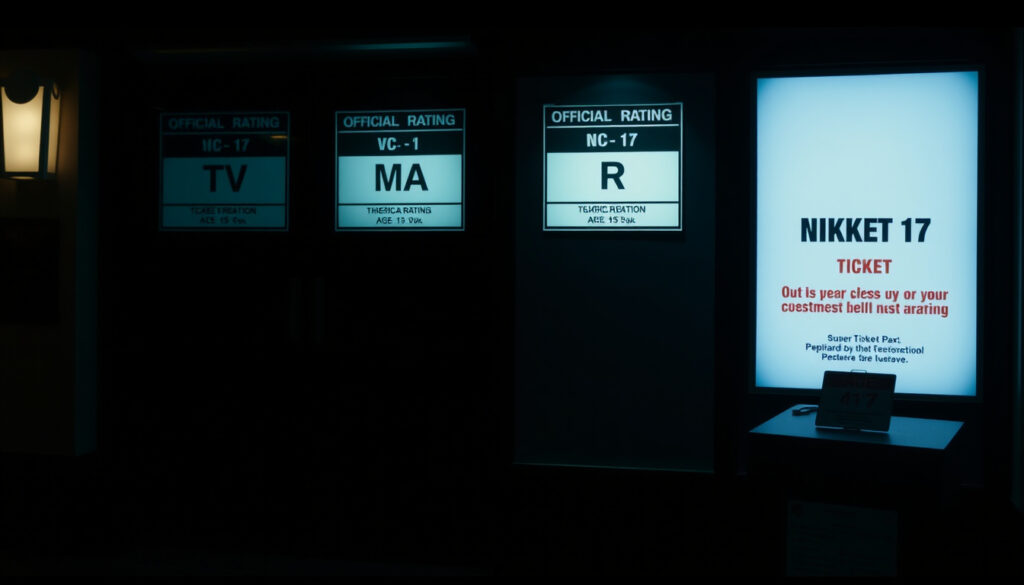
TV-MA vs R vs NC-17: Age Rules, Content & Enforcement
Anyone who has paused over a small “TV-MA” tag beside a show has asked the same question: is that a hard rule, or just a label? The answer depends on whether the content is on television or in a theater, because TV-MA, R, and NC-17 come from two different rating systems.
Full Name: TV-Mature Audience · Age Restriction: 17+ (guideline) · Content Descriptors: L (language), S (sex), V (violence) · Introduced: 1996 · Applicable To: U.S. television programming
Quick snapshot
- TV-MA is a U.S. television rating under the TV Parental Guidelines (Wikipedia’s TV Parental Guidelines entry)
- Designed for adult audiences and may be unsuitable for children under 17 (FCC program-rating guidance)
- TV ratings are advisory, not a universal admission-control system (TV Parental Guidelines history)
- Whether TV-MA is “scarier” than R is subjective and depends on the specific content, not the rating alone
- Streaming services are not held to one federal age-gate standard, so enforcement varies by platform
- The system was created in response to mature-content concerns and possible legislation (EBSCO research starter)
- The original labels included TV-G, TV-PG, TV-14, and TV-MA before content descriptors were added (Encyclopedia.com television ratings history)
- For parents: check the L, S, and V descriptors, not just the rating
- For teens: TV-MA is a 17+ signal even if no one checks
- For producers: TV-MA remains the mainstream adult label for TV and streaming
Eight quick facts, one pattern: TV-MA’s legal force depends on where the content is shown, not on the label itself.
| Label | Value |
|---|---|
| Full Name | TV-Mature Audience |
| Age Restriction | 17+ (advisory) (FCC program-rating guidance) |
| Content Descriptors | V (violence), S (sexual content), L (strong or coarse language), plus D and FV in the broader system (FCC program-rating guidance) |
| Introduced | 1996; implementation began Jan. 1, 1997 (TV Parental Guidelines history) |
| Governed By | TV Parental Guidelines, an industry-FCC framework |
| Typical Content | Crude or indecent language, explicit sexual activity, graphic violence |
What Does TV-MA Mean?
TV-MA stands for TV-Mature Audience, and it is the most adult-oriented tier in the U.S. TV Parental Guidelines. The system was developed in response to concerns about mature content and possible legislative action, according to EBSCO’s research starter.
What Does “MA TV” Mean?
- TV-MA = TV-Mature Audience
- “MA TV” is the same label, not a separate rating
- Age clue = 17+ advisory
Another way to read it: the rating assumes a viewer has adult judgment about language, sex, and violence.
What Does TV-MA Mean on Netflix?
TV-MA on a streaming screen is still the TV Parental Guidelines label. It tells you the show is adult-oriented; it does not tell you whether a platform will block a younger viewer.
In practice, TV-MA can describe anything from a gory thriller to an explicit comedy, which is why the content descriptors matter as much as the rating itself.
The pattern: TV-MA is a shorthand signal for adults. The signal is useful, but parents still need to look closer.
Is TV-MA the Same as R?
No, although the two labels feel similar. TV-MA applies to television, R applies to theatrical films, and the Motion Picture Association is explicit that they are not interchangeable legal classifications (Motion Picture Association rating FAQ).
An R-rated movie restricts admission: viewers under 17 need a parent or adult guardian. That is an enforcement point, not just advice.
Is TV-MA Scarier Than R?
- R is a theatrical rating; TV-MA is a television rating
- R has an admission rule; TV-MA does not
- Neither rating has a single “scariness” measure
The City of High Point’s MPAA summary notes that an R rating can be triggered by strong language, violence, nudity, drug abuse, thematic material, or a combination — so an R film is not always “worse” than a TV-MA show.
The trade-off: R has the theater ticket check; TV-MA relies on whoever holds the remote.
Is TV-MA Appropriate for 12 Year Olds?
A direct answer: no. The FCC’s guidance for TV-MA says the content may be unsuitable for children under 17, which places a 12-year-old outside the intended audience (FCC program-rating guidance).
That does not mean every TV-MA episode is equally intense. It means the rating is a poor starting point for a 12-year-old, and a parent should look at the specific descriptors before allowing an exception.
The label will not do the parenting for you. A streaming service can mark a show TV-MA without requiring proof of age, so the most important check happens before the episode starts.
The implication: TV-MA tells you the content was built for adults. A 12-year-old is exactly the viewer the rating is trying to flag.
How Does TV-MA Compare to NC-17?
NC-17 is the clearest hard-line rating in U.S. movies. According to the Motion Picture Association rating FAQ, an NC-17 film is patently adult, and no one 17 or under is admitted, even when accompanied by an adult.
TV-MA does not work that way. The TV Parental Guidelines describe the ratings as designed to give parents advance cautionary information rather than to function as a universal admission-control system (TV Parental Guidelines history).
That is the practical difference: a 16-year-old can stream a TV-MA show at home, but the same teen cannot walk into an NC-17 screening.
The implication: NC-17 has a velvet rope; TV-MA has a warning label. If you are comparing strictness, NC-17 wins every time.
Is TV-MA Equivalent to PG-13?
No. PG-13 sits below the adult tier in the movie system, while TV-MA sits in the adult tier of the television system.
Is PG-13 or Rated R Worse?
- PG-13: parents strongly cautioned; under-13 is the rough threshold
- R: under-17 requires a parent or adult guardian (Motion Picture Association rating FAQ)
- TV-MA: adult-oriented television, 17+ advisory
A PG-13 movie can push boundaries, but TV-MA is designed for a viewer at least four years older. If you are mapping the two systems, TV-MA belongs with R and NC-17, not PG-13.
The pattern: TV-MA and PG-13 are not neighbors. The TV rating is an adult label, and it should be treated that way.
TV-MA vs R vs PG-13 vs NC-17: Side-by-Side
Four ratings, one pattern: the theatrical ratings turn age policy into a ticket rule, while TV-MA turns it into a parenting prompt.
| Dimension | TV-MA | R | NC-17 |
|---|---|---|---|
| Applies to | TV and streaming | Movies | Movies |
| Age threshold | 17+ advisory | Under 17 requires parent/guardian | No one 17 or under admitted |
| Enforcement | Parent or viewer | Theater admission policies | Theater admission policies |
| Content descriptors | V, S, L, D, FV | Violence, language, sex, drugs, themes | Patently adult content |
| Typical content | Crude/indecent language, explicit sexual activity, graphic violence | Strong content of various types | Adult content with no under-17 admission |
The catch: TV-MA is the most flexible of the three adult labels because it travels across screens without a ticket check.
What’s Confirmed, What’s Still Unclear
Confirmed
- TV-MA is part of the U.S. TV Parental Guidelines
- TV-MA may be unsuitable for children under 17
Still unclear
- Whether TV-MA is “scarier” than a given R-rated film depends on the content, not the rating
- How strictly streaming platforms should enforce the 17+ guidance is not standardized
- R restricts admission for under-17s unless an adult is present, but enforcement can vary by theater
- NC-17 prohibits admission for anyone 17 or under, though this is a theater policy, not federal law
The pattern: the confirmed facts tell parents what the label means; the unclear part is how strictly any given platform applies it.
What the Ratings Bodies Say
This program is specifically designed to be viewed by adults and therefore may be unsuitable for children under 17.
TV Parental Guidelines
An R rating does not identify one fixed content threshold; it can result from strong language, violence, nudity, drug abuse, thematic material, or combinations of these elements.
The takeaway: both bodies describe ratings as information tools, not courtroom verdicts.
Parents are the real enforcement point here. TV-MA is a meaningful signal, but it is advisory, so it will not stop a curious 12-year-old from tapping play. For a parent, the decision is clear: treat TV-MA as a 17-and-up label, check the L, S, and V descriptors, and use that extra minute to decide whether a younger teen is ready.
Frequently asked questions
What content descriptors are used with TV-MA?
The TV Parental Guidelines include V (violence), S (sexual content), D (suggestive dialogue), L (strong or coarse language), and FV (fantasy violence). TV-MA is most often associated with L, S, and V.
Can a 16-year-old watch TV-MA shows?
TV-MA is advisory for 17 and older, so a 16-year-old is outside the intended audience. Unlike R or NC-17, there is no theater-door rule attached to TV-MA.
Is TV-MA the same as TV-14?
No. TV-14 warns that content may be unsuitable for children under 14, while TV-MA is aimed at adults 17 and older.
What is the difference between TV-MA and TV-Y7?
TV-Y7 is made for children ages 7 and older; TV-MA is made for adult viewers 17 and older.
How does Netflix label TV-MA content?
Netflix uses the standard TV Parental Guidelines label, so TV-MA on Netflix means the same thing it means on broadcast TV: adult-oriented content.
Do any streaming services enforce TV-MA age restrictions?
Some services offer parental controls, but the ratings themselves are advisory. There is no federal requirement that a streamer block TV-MA content for minors.
More related posts