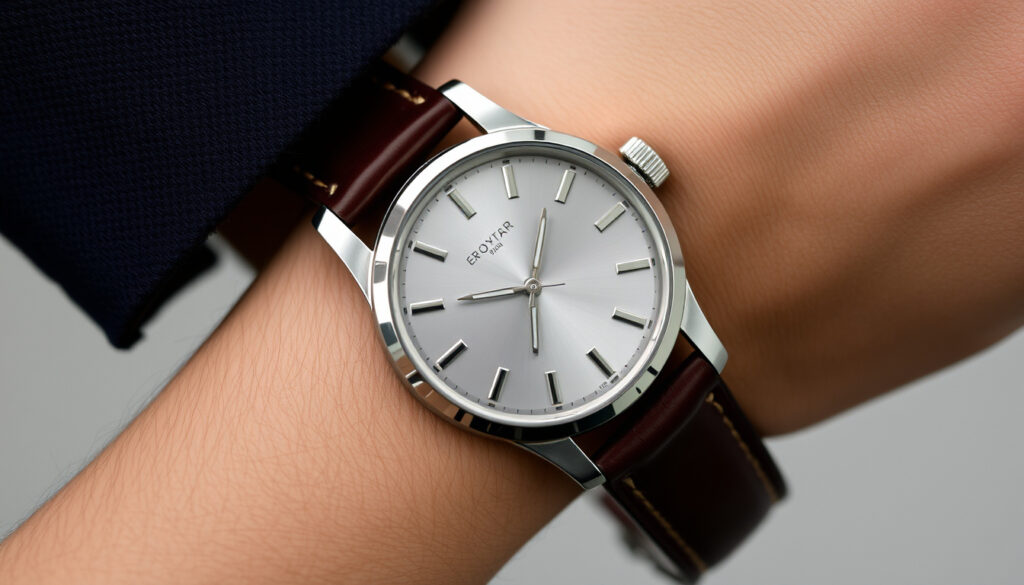
Where Should a Watch Sit on Your Wrist? Fitting Guide
There’s a small, quiet moment we’ve all had: you glance down at your wrist and the watch has slid toward your hand, or it’s sitting crooked, or it just feels a little off. You’re not sure if it’s the strap, the case size, or if you’re simply wearing it wrong. The truth is, most of us never got the memo on where exactly a watch is supposed to rest, and the internet is full of conflicting advice. This guide cuts through the noise to settle the question with practical, source-backed guidance, covering everything from the traditional rules of placement to the modern debate about the non-dominant hand. We’ll look at why the “just above the bone” rule exists, why your watch might not work on some people, and how to find a fit that is both comfortable and looks intentional, addressing the five areas people ask about most: positioning, left vs. right, fit, etiquette, and trends.
Positioning: The Wrist Bone and the Forearm
The most common piece of advice, repeated across nearly every guide we examined, is that the watch should sit just above the wrist bone on the flatter part of the forearm, not directly on the joint itself. According to TrueFacet (watch retailer and expert guide), the watch should sit on the flat portion of the wrist and not dangle over the hand or ride up the forearm.
- The “sweet spot”: Just behind the wrist bone, not on it, and not sliding onto the hand.
- The mistake: Wearing it directly on top of the wrist bone, which can cause discomfort during movement, as noted by Watch Police (watch guide).
The bone acts as a natural anchor; the watch should nestle just behind it where the arm is slightly flatter, preventing it from digging in when you flex your hand.
A properly fitted watch should not slide down onto the hand, nor should it ride up toward the elbow. Timex (watch manufacturer) emphasizes that the watch should sit just behind the wrist bone, and when wearing a long-sleeved shirt, it should remain visible mainly when the arm is extended, not constantly poking out from the cuff. This placement is about both comfort and style, ensuring the watch doesn’t interfere with your hand’s range of motion.
The position is also a matter of practicality. One guide notes that the watch should not be pressed against the hand and should not ride up the arm, a common issue with loose straps, according to Watch Police (how-to guide). The same source recommends keeping the watch behind the bone with a small breathing room so it does not perch on the bump.
The upshot
This isn’t about a random rule; it’s an ergonomic guideline. By keeping the watch off the joint, you allow for natural wrist flexion without the case digging into your hand or putting pressure on the bone.
Left vs. Right: The Dominant Hand Debate
Conventional style guides traditionally recommend wearing a watch on the non-dominant wrist. This is the hand you use less, which reduces the risk of scratching the watch against objects like desks and doorknobs during everyday activities. This advice is often presented as a style convention rather than a strict etiquette law. As Watch Police (comparison guide) points out, the non-dominant wrist is a style and convenience norm rather than a strict rule, a sentiment echoed by their Watch Obsession (retailer blog). The core logic is simple: a right-handed person uses their left hand less, so the watch suffers less wear and tear and is less likely to be knocked against things.
However, this is far from a hard-and-fast rule. Many left-handed people choose to wear their watch on their right wrist out of comfort, and many right-handed people find their non-dominant hand simply feels “wrong” for a watch strap. The rule is a default, not a dictate. There is no strong personality correlation that dictates which wrist you should use; it’s purely a matter of practicality and personal comfort, as confirmed by a review of various guides.
Why this matters
Choosing the non-dominant wrist is about protecting your investment. It’s a practical choice that minimizes dings and scratches. But if you’re a lefty who wears on the left, or a righty on the right, you’re breaking a convention, not a law. The physical comfort and the fit issues should always trump tradition.
Fit and the Myth of “Wrist Type”
There is no strict rule about which “type” of person should wear a watch, and claims that certain personalities are drawn to certain wrists are anecdotal at best. As noted in our research, no strong personality correlation exists for watch placement, only anecdotal claims. Instead of focusing on your personality, the most important factor is the physical fit itself. A properly fitted watch should sit firmly behind the wrist bone, not on it, and not over the hand.
Here’s a breakdown of what to check for a proper fit:
| Fit Element | What it Means |
|---|---|
| Recommended position | Just behind the wrist bone on the forearm, not on the hand. |
| Common fit mistake | Wearing it over the wrist bone causing discomfort or wearing it tight enough to leave a mark. |
| Traditional view | The watch should sit high enough that the wrist joint has a full range of motion. |
| Modern trend | Some prefer a looser fit that allows slight movement, while others like it snug. |
The 1916 Company (luxury watch seller) advises that a watch should be positioned just behind the wrist bone on the forearm side, not on the hand, above the wrist bone for comfort and movement. This placement ensures the watch stays put when you bend your wrist and doesn’t restrict movement.
The catch
The real enemy of a good fit is constant movement. A watch that slides around your arm isn’t just a style nuisance; it’s a sign the strap is too loose. Your goal is a fit that’s secure enough to stay in place without being so tight that it leaves a red mark or restricts blood flow.
Why Do Watches “Not Work” on Some People?
The question of why a watch might not work on certain people usually has nothing to do with magic and everything to do with anatomy and fit. For some, the issue is a prominent wrist bone that makes it difficult for the watch to sit flush. For others, it’s a very flat or very round wrist shape that makes it hard to find a secure fit without the watch rotating.
The issue is rarely the person themselves but the interaction between the watch’s case size and the wrist. A watch with a case that is too large will overhang the edges of a small wrist, making it catch on sleeves and feel heavy. A watch that is too small on a large wrist will seem to swim around. The key is that most watches can be made to work with the right strap length and adjustment. If a watch “doesn’t work” on your wrist, it’s often because the strap is too tight or too loose, not because you’re doing something inherently wrong.
The paradox
It seems the very thing that makes a watch feel good—a snug fit against the bone—is also what makes it “work” for a given person. When a watch doesn’t fit, it’s often because the wearer has the case sitting on top of the bone, creating pressure points. Once you shift it to the flatter part of the forearm, most comfort issues resolve themselves.
Practical Fit, Not Just Placement
Placement is only half the equation; the other half is actual tightness. A watch that sits correctly but whose strap is too loose will slide forward onto the hand the moment you extend your arm. Conversely, a strap that is too tight will feel restrictive and can cause skin irritation. Watch Police (fit guide) emphasizes that the watch should not be pressed against the hand and should not ride up the arm, indicating a need for a balance. The goal is a fit that feels secure but not constrictive, a “smart” tightness.
Most experts agree that the traditional advice is to wear the watch on the non-dominant hand, but this is more about style and convenience than a strict rule. The most important factor is that the watch doesn’t impede your movements. The gap between the watch case and your skin should be just enough to fit a finger, ensuring it’s not too tight. Wearing it too high on the forearm, above the wrist bone, can cause it to roll around, while wearing it on the hand reduces range of motion and makes it more likely to get caught on things.
What to watch
Watch for the “hangover” test: when your arm is relaxed at your side, the watch should not be resting on your hand. If it is, it’s too loose. A properly fitted watch will stay just behind the bone, a small detail that makes a big difference in both comfort and how it looks under a sleeve.
precisionwatches.com, precisionwatches.com, lewatchbuyers.com, chronometercheckblog.com, garminwatch.blog, reddit.com, getwatchmaker.com
Frequently Asked Questions
When should you not wear a watch?
You should not wear a watch when you’re about to engage in high-impact sports like tennis or weightlifting, as the constant impact against your wrist can cause discomfort or damage the movement. Similarly, it’s best to remove it before swimming in a hot shower or sauna if it’s not rated for high temperatures and pressure, as steam can damage the seals and cause condensation. Finally, formal black-tie events often call for no watch at all, as the focus is on classic elegance, and a loud, bulky case can disrupt the clean lines of a tuxedo.
Why do watches not work on certain people?
This typically comes down to a physical fit issue rather than a person-specific factor. A watch “doesn’t work” when the case is too large for a flat wrist, causing it to slide and rotate uncomfortably. Or, it might be that the strap is too long and the watch head sits awkwardly on the wrist bone. In many cases, a person might have a skin reaction to the metal in the case or strap, which has nothing to do with the watch’s mechanism. It’s often a matter of finding a different case size or strap material, not a universal problem with wearing a watch.
Why do watches not work on certain people?
This is a common question that often stems from a misunderstanding of fit. It’s not that watches are incompatible with certain people, but that the watch and the wrist aren’t a good match in terms of proportions. A oversized watch might continuously slide to the side, making it feel unbalanced. Similarly, a watch with a short strap might be too tight for someone with a thicker wrist. The issue is almost always the relationship between the case size, the strap length, and the wrist’s shape—all of which can be adjusted or changed to achieve a perfect fit.
Is it bad to wear a watch on the wrist bone?
It is generally not advised to wear a watch directly on the wrist bone. This spot is where the radius bone and the wrist joint meet, and wearing a watch here can cause discomfort when you bend your hand. The constant pressure and friction can also irritate the skin. The recommended placement is just behind the bone, on the flatter part of the forearm, where the watch rests naturally without digging into the joint or restricting your movement. It’s a small shift in position that makes a significant difference in day-to-day comfort.
What is the “correct” wrist to wear a watch on?
Traditionally, the “correct” wrist is the non-dominant one—so the left for right-handed people and the right for left-handed people. This is rooted in practicality; it keeps the watch out of the way during active hand usage, reducing the risk of scratches. However, in modern times, there’s no strict rule, and many people wear a watch on their dominant hand for comfort or because they simply prefer it. The true “correct” choice is whichever wrist feels more comfortable and allows the watch to sit flat and secure.
More related posts
 Shawn Wayans: Biography, Net Worth, and Family Facts
 Cast Of Inside Out 2
 Last Of Us Cast
 Get Healthy U TV Review: Pricing, Workouts & More
 Best Xbox Series X Headset 2026: Expert Tested & Buyer Guide
 Peacemaker Season 3 Cancelled? Season 2, LGBTQ & More
 Cast Of Black Doves
 Cast Of Joker Folie À Deux
