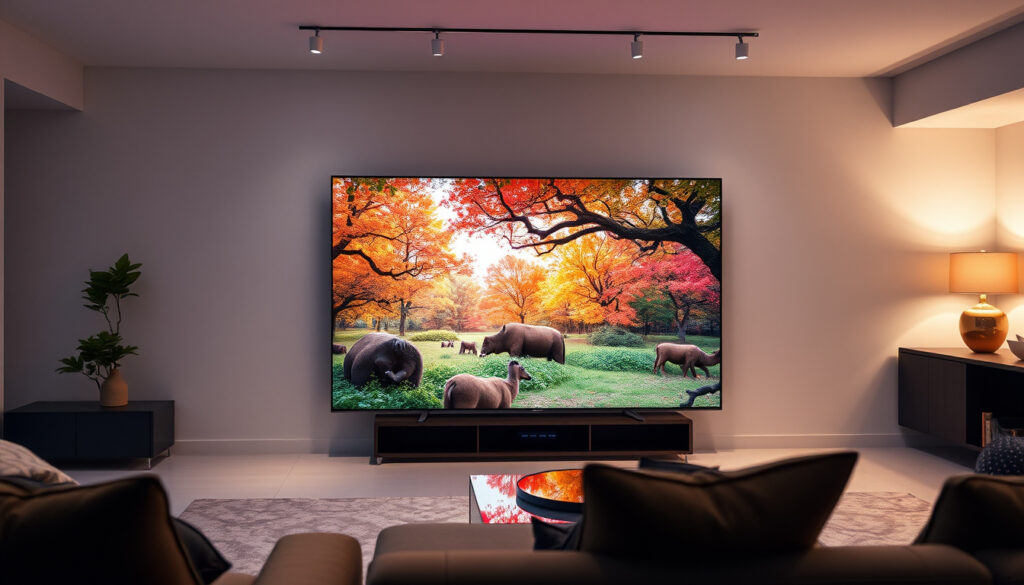
What Is OLED TV? Guide to OLED Tech, Pros and Cons
You’ve seen the jaw-dropping picture at a friend’s house — blacks so deep the screen looks off when it’s actually on. That’s OLED, and it’s a different beast from the LED TV you’ve probably owned for years.
OLED pixel response time: 0.1 ms ·
Contrast ratio: Infinite (true blacks) ·
Viewing angle: 178 degrees ·
Average lifespan: 100,000 hours ·
No backlight required: Self-emissive pixels
Quick snapshot
- OLED pixels emit light individually, enabling true blacks (RTINGS (independent display reviewer))
- OLED TVs are more expensive than equivalent LED TVs (ConsumerAffairs (consumer advocacy))
- Burn-in is a potential issue with static content (RTINGS)
- OLED lifespan is approximately 100,000 hours (LG USA (manufacturer))
- Exact peak brightness levels vary by model and manufacturer (RTINGS)
- Long-term durability vs mini-LED is still debated (TechRadar (tech news outlet))
- Whether OLED or QLED is better for eye strain depends on individual usage patterns (RTINGS)
- Lifespan estimates vary: TCL suggests 8-10 years, while LG and Samsung claim up to 100,000 hours (ConsumerAffairs) (RTINGS)
- No significant timeline data available
- OLED prices are expected to continue falling as production scales
- Mini-LED and MicroLED are emerging alternatives
Here are the key specifications of OLED TV technology.
| Attribute | Value |
|---|---|
| Technology type | Self-emissive organic pixels |
| Contrast ratio | Infinite (theoretical) |
| Response time | 0.1 ms |
| Viewing angle | 178 degrees |
| Average lifespan | 100,000 hours |
| Burn-in risk | Yes, from static images |
What is an OLED TV?
How does OLED technology work?
- OLED stands for Organic Light Emitting Diode. Each pixel contains organic compounds that emit light when an electric current passes through them (LG USA).
- Because every pixel generates its own light, no backlight is needed — the TV can turn off individual pixels completely to produce absolute black (RTINGS).
- This self-emissive design also allows for thinner panels and greater flexibility than traditional LED TVs (Samsung US (manufacturer)).
The implication: OLED’s per-pixel light control is the fundamental reason it delivers contrast that backlit LCD/LED displays simply cannot match — each pixel is either on or off, with no light bleeding across the screen.
What makes OLED different from LED and QLED?
- LED and QLED TVs use a separate backlight layer (either edge-lit or full-array) that shines through liquid crystals and color filters. Black levels suffer because backlight leakage causes grayish blacks (RTINGS).
- QLED adds a quantum dot film to improve color volume and brightness, but it still relies on a backlight — so it can’t achieve true black (Samsung US).
- OLED panels are also much thinner — some models are under 5 mm deep — and offer uniform color from almost any angle (RTINGS).
The trade-off: while OLED excels in black levels and contrast, it cannot match the peak brightness of a high-end QLED set — a key difference for very bright rooms where reflections wash out the picture.
Which is better, QLED or OLED or LED?
OLED vs QLED: picture quality differences
- OLED wins on contrast and black depth — each pixel turns off completely, giving an infinite contrast ratio (RTINGS).
- QLED (Quantum Dot LED) can achieve higher peak brightness, often exceeding 1,500 nits, making it better for HDR highlights in bright rooms (Samsung US).
- OLED has wider viewing angles — colors and contrast remain accurate up to 178 degrees, while QLED suffers from color shift off-center (RTINGS).
The pattern: OLED is the choice for dark-room movie nights; QLED is the better option for bright living rooms with lots of ambient light.
OLED vs LED: contrast and black levels
- Standard LED TVs (edge-lit or full-array without local dimming) have poor black levels — black areas appear gray because the backlight is always on (RTINGS).
- Even full-array local dimming (FALD) LED TVs can only approximate OLED blacks; blooming around bright objects is common (TechRadar).
- OLED’s per-pixel control eliminates blooming entirely, giving clean edges around bright text or objects on dark backgrounds (RTINGS).
The catch: LED TVs are significantly cheaper for the same screen size, and they don’t carry burn-in risk — a trade-off between image purity and peace of mind.
Brightness and HDR performance
- OLED panels typically peak around 800–1,000 nits for full-screen white, while high-end QLED sets can reach 2,000 nits (RTINGS).
- For HDR content, OLED’s near-infinite contrast can make highlights appear more impactful even at lower brightness levels — the eye perceives the contrast ratio more than raw luminance (ConsumerAffairs).
- In very bright rooms, OLED’s lower peak brightness means reflections can be more distracting than on a QLED (ConsumerAffairs).
Six technologies, one pattern: the choice boils down to your room’s lighting and your tolerance for blooming vs. burn-in risk.
| Feature | OLED | QLED | LED (standard) |
|---|---|---|---|
| Backlight | None (self-emissive) | Full-array LED + quantum dot layer | Edge-lit or full-array LED |
| Black levels | True black (infinite contrast) | Deep but not black (blooming possible) | Gray-black (backlight bleed) |
| Peak brightness | 800–1,000 nits | 1,500–2,000 nits | 500–1,000 nits |
| Viewing angle | 178° (excellent) | ~120° (color shift off-axis) | ~120° (color shift off-axis) |
| Burn-in risk | Yes (static content) | No | No |
| Average price (55″) | $1,000–$1,500 | $800–$1,200 | $400–$700 |
The implication: if picture quality is your top priority and you can control lighting, OLED is the undisputed winner. If you need a bright room TV or want to avoid any burn-in worry, QLED is the smarter choice.
TL;DR: OLED wins on black levels and viewing angles; QLED wins on brightness and price. For dark rooms, go OLED. For bright rooms, QLED or LED are more practical.
What are the disadvantages of an OLED TV?
Burn-in risk and image retention
- Burn-in occurs when static elements (logos, news tickers, game HUDs) cause uneven pixel wear. RTINGS’ long-term test found that all OLED TVs in its test showed some permanent burn-in over time (RTINGS).
- However, under mixed usage (streaming, movies, varied games), burn-in is rare. Tom’s Hardware reported that a three-year test of 102 TVs found OLED burn-in was not a real issue except in extreme torture-test scenarios (Tom’s Hardware (PC hardware site)).
- Manufacturers include pixel refresh features and screen savers to mitigate the risk. LG advises reasonable, responsible use combined with image-preservation features (LG USA).
Lower peak brightness compared to QLED
- OLED’s peak brightness is limited because driving organic pixels to very high luminance accelerates degradation. Most OLEDs top out around 1,000 nits, while premium QLEDs can exceed 2,000 nits (RTINGS).
- This means HDR content in bright rooms may look less punchy on OLED, and reflections can be more noticeable (ConsumerAffairs).
Higher price per inch
- OLED manufacturing is more complex and yields are lower, so the price per screen inch is higher than LED or QLED (ConsumerAffairs).
- For example, a 55-inch OLED typically costs $300–$500 more than a comparable QLED, and $600–$800 more than a standard LED (RTINGS).
Shorter lifespan than some LED models
- OLED’s organic materials degrade over time, with an average lifespan of 100,000 hours (about 10–15 years at normal viewing) (LG USA).
- Some LED TVs are rated for up to 200,000 hours, though they can develop backlight failures (RTINGS).
- ConsumerAffairs reports that TCL pegs OLED lifespan closer to 8–10 years, while Sony says OLEDs should last about as long as LCD models (ConsumerAffairs).
OLED buyers trade a slightly shorter lifespan and burn-in risk for the best picture quality available. For most users who watch varied content, the risk is manageable — but heavy users of news channels or gaming HUDs should think twice.
Upsides
- Best-in-class contrast and black levels
- Wide viewing angles (178°)
- Fast response time (0.1 ms) — ideal for gaming
- Slim and elegant design
Downsides
- Burn-in risk with static content
- Lower peak brightness than QLED
- Higher price per inch
- Shorter lifespan than some LED/LCD models
Are OLED TVs worth buying?
Who should buy an OLED TV?
- Home theater enthusiasts who watch movies in a dark room will see the biggest benefit from OLED’s perfect blacks (ConsumerAffairs).
- Gamers who play a variety of titles and don’t leave static HUDs on screen for hours will enjoy the fast response and excellent motion handling (RTINGS).
- People who rotate between streaming, movies, and games — rather than leaving one static channel on all day — are ideal OLED candidates (ConsumerAffairs).
OLED vs LED for gaming and movies
- For movies: OLED’s contrast and black levels create a cinematic experience that LED cannot match, especially in dark scenes (RTINGS).
- For gaming: OLED’s 0.1 ms response time eliminates motion blur, and its low input lag (typically 10–15 ms) is competitive with gaming monitors (RTINGS).
- But if you play the same game for 500 hours with a static HUD, burn-in risk increases. LED TVs are more forgiving for marathon gaming sessions (TechRadar).
Price vs performance value
- OLED prices have dropped significantly in recent years, but they still command a premium. A 55-inch OLED costs around $1,000–$1,500 vs. $500–$800 for a comparable LED (RTINGS).
- If you watch mostly sports or news in a bright room, the extra cost may not be justified. If you watch movies and premium streaming content, many owners say the investment is worth it (ConsumerAffairs).
The consequence: for the home theater purist, OLED is the only choice. For the budget-conscious or bright-room viewer, the premium is hard to justify.
What is the average lifespan of an OLED TV?
How many hours do OLED TVs last?
- LG states its OLED panels can reach 100,000 hours under reasonable usage conditions (LG USA).
- Samsung says OLED TVs typically last 50,000 to 100,000 hours, or about 10 to 20 years of normal viewing (Samsung US).
- ConsumerAffairs reports that TCL estimates OLED lifespan closer to 8–10 years, while Sony says OLEDs should last about as long as traditional LCD models (ConsumerAffairs).
Factors that affect OLED lifespan
- Brightness setting: higher brightness accelerates organic pixel degradation. Samsung advises avoiding static images and adjusting brightness to maximize lifespan (Samsung US).
- Static content: leaving a news ticker or logo on screen for hours reduces the lifespan of those pixels. RTINGS attributes burn-in to uneven subpixel degradation (RTINGS).
- Modern OLEDs include pixel refresh cycles and screen savers that help maintain uniformity over time (LG USA).
OLED vs LED lifespan comparison
- LED/LCD TVs do not degrade in the same way as OLEDs, but they can develop dark spots from backlight failure (RTINGS).
- Tom’s Hardware found that in a three-year reliability test, OLED was significantly more reliable than LCD, with most OLEDs lasting more than 10,000 hours of continuous use (Tom’s Hardware).
- TechRadar reported that RTINGS found OLEDs tended to be the most reliable in their long-term test, while edge-lit LCDs were the least reliable (TechRadar).
One comparison, one surprise: the test data shows that while OLED burn-in is a real concern, overall reliability can actually be better than entry-level LCDs — the real enemy is not OLED itself but very heavy static usage.
| Specification | OLED | LED/LCD |
|---|---|---|
| Average lifespan | 50,000–100,000 hours (Samsung) | Up to 200,000 hours (backlight dependent) |
| Burn-in risk | Yes | No |
| Response time | 0.1 ms | 5–15 ms |
| Contrast ratio | Infinite (theoretical) | 1,000:1 to 5,000:1 (with local dimming) |
| Viewing angle | 178° | ~120° |
| Peak brightness | 800–1,000 nits | 500–2,000 nits |
| Energy consumption (55″) | ~100–150 W | ~80–120 W |
The takeaway: OLED beats LED on contrast, response time, and viewing angles, but lags in brightness and raw lifespan. The gap in reliability, however, is smaller than many assume.
“OLED TV uses a unique screen technology that doesn’t require a backlight. Each pixel produces its own light, allowing for perfect blacks and infinite contrast.”
— LG UK
“OLED TV represents a significant advancement in display technology. It offers superior picture quality, a slimmer design, and better energy efficiency compared to traditional LCD TVs.”
— Philips UK
“OLED panels use self-lighting pixels that emit their own light. OLED displays produce vibrant colours and deep blacks, making them ideal for home cinema enthusiasts.”
— Crampton and Moore (specialist retailer)
For the average buyer in the US, the choice is clear: OLED if you want the best picture quality and watch varied content in a controlled-light room; QLED or LED if you need a bright screen, have a tight budget, or plan to use the TV as a monitor with static elements. The premium for OLED is shrinking, but it’s still a premium — one that pays off every time the credits roll on a dark movie scene.
blog.panoxdisplay.com, samsung.com, cramptonandmoore.co.uk, qledvsoled.com, tomshardware.com, slashgear.com, displaymodule.com
Frequently asked questions
What is the difference between OLED and QLED?
OLED uses self-emissive pixels that turn off individually for true blacks. QLED uses a backlight with a quantum dot layer for higher brightness but cannot achieve absolute black. OLED is better for dark rooms, QLED for bright rooms.
Do OLED TVs suffer from burn-in?
Yes, prolonged display of static images (logos, scoreboards, news tickers) can cause uneven pixel wear that leads to permanent burn-in. Under normal mixed usage, the risk is low. Manufacturers include mitigation features like pixel refreshers.
How long do OLED TVs last?
Most manufacturers rate OLED panels for 50,000 to 100,000 hours of use, which translates to about 10–15 years of average viewing. Real-world lifespan depends on brightness settings and content types.
Are OLED TVs good for gaming?
Yes, OLEDs have extremely fast response times (0.1 ms) and low input lag, making them excellent for gaming. However, gamers who play the same title with a static HUD for hundreds of hours should be aware of burn-in risk.
Is OLED better than LED for watching movies?
For movies, OLED is widely considered superior because of its perfect blacks, infinite contrast, and wide viewing angles. LED TVs cannot match the cinematic depth of OLED in dark scenes.
What is the price range of OLED TVs?
As of 2025, 55-inch OLED TVs typically cost between $1,000 and $1,500. 65-inch models range from $1,500 to $2,500. Prices have been dropping steadily as production scales.
Can OLED TVs be used as computer monitors?
Yes, but the risk of burn-in is higher due to static desktop elements (taskbar, icons). Many users employ screen savers and hide the taskbar. For mixed use, OLED monitors are now available.
More related posts