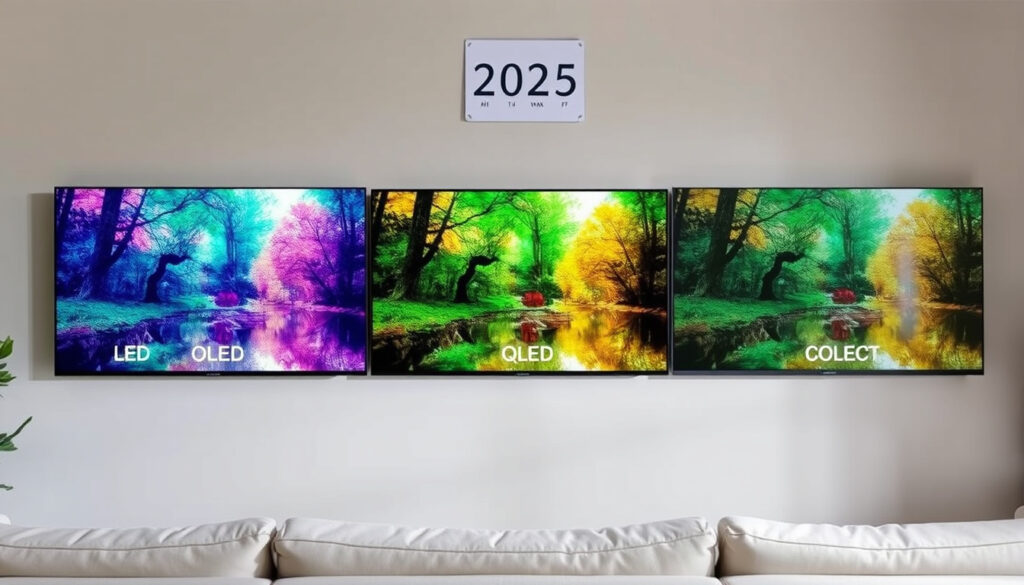
LED TV vs OLED vs QLED: Which is Better for You in 2025
You’ve seen the acronyms LED, OLED, QLED on TV boxes, but they don’t actually tell you what’s inside. The truth is simpler than the marketing suggests: almost every TV sold today uses some form of LED backlighting, and the real choice comes down to how that light is controlled. This guide cuts through the jargon to show you exactly what each technology delivers—and what it costs you in picture quality, longevity, and practical use.
LED TV market share (2024): Over 60% of all TVs sold in 2024 used LED backlighting ·
Average lifespan of an LED TV: 50,000 to 100,000 hours of use (approx. 5-11 years at 8 hours/day) ·
Cost difference vs OLED (55-inch): LED TVs are typically 30-50% cheaper than comparable OLED models ·
Contrast ratio: Standard LED TVs have a contrast ratio of ~1,000:1, while OLED can achieve 1,000,000:1
Quick snapshot
- LED TVs use a backlight; OLED does not. (Consumer Reports (independent testing lab))
- LED TVs are brighter than OLED (peak brightness 600–2,000 nits vs 400–1,000 nits). (RTINGS.com (tech review lab))
- LED TVs have longer lifespan than OLED (50,000+ vs 30,000–50,000 hours). (What Hi-Fi? (audio-visual experts))
- Exactly how many local dimming zones are needed for near-OLED contrast is still debated.
- Burn-in risk of modern OLED is disputed; newer models include pixel refresher features that reduce it.
- 2007–2009: First consumer LCD TVs with LED backlighting (e.g. Sony Bravia XBR8). (Crampton & Moore (UK retailer))
- Mini-LED backlighting is narrowing the gap to OLED contrast while keeping LED price and brightness advantages. (Samsung US (manufacturer))
Four key specs, one pattern: LED technology is defined by its backlight, and that backlight determines everything from price to picture quality.
| Specification | Value |
|---|---|
| Definition | LED TV = liquid crystal display (LCD) illuminated by light-emitting diodes (LEDs). |
| Typical lifespan | 50,000–100,000 hours (backlight dims gradually). |
| Contrast ratio (typical) | 1,000:1 (standard), up to 10,000:1 with full-array local dimming. |
| Price range (55-inch, 2024) | €350–€800 for standard LED; €800–€1,500 for QLED/Mini-LED. |
Which is better, TV LED or LCD?
To answer that, you first need to know that LED and LCD are not competitors—they’re parent and child. Every LED TV is an LCD TV that uses LED backlighting instead of the older CCFL (cold-cathode fluorescent) tubes. As Consumer Reports (independent testing lab) makes clear, “LED TV” in consumer guides almost always refers to an LCD TV with LED backlighting, not a self-emissive panel.
What does LED mean in a TV?
- LED stands for light-emitting diode. In a TV, an array of LEDs sits behind or along the edges of the LCD panel to provide the light source.
- This backlight passes through liquid crystals that twist to let light through, creating the image.
- Because LEDs are small and efficient, LED-backlit TVs can be thinner, brighter, and more energy-efficient than the CCFL LCDs sold before 2010. (Samsung US (manufacturer))
What does LCD mean in a TV?
- LCD stands for liquid crystal display. The liquid crystals themselves do not emit light; they need a backlight.
- Modern “LCD” almost always refers to an LED-backed LCD. The old CCFL-backlit variants are effectively extinct in the consumer market.
- The key takeaway: when you buy a TV labelled “LED”, you’re buying an LCD. When you buy an “LCD” today, you’re almost certainly buying an LED. The terms are interchangeable in practice. (RTINGS.com (tech review lab))
Buyers in bright living rooms get more value from LED backlighting than from chasing the “pure black” marketing claims. A mid-range LED at €500 will outperform a budget OLED in a sunlit room, because LED peak brightness is simply higher.
For typical Irish homes: LED-backlit LCD is the practical choice, delivering brightness and affordability without the complexity of OLED.
Which TV is better, OLED or LED?
This is the most common fork in the road. The choice comes down to a fundamental trade-off: perfect blacks vs. peak brightness.
Picture quality: contrast and black levels
- OLED pixels emit their own light, which allows individual pixels to turn completely off, producing true blacks and infinite contrast. (Samsung US (manufacturer))
- LED TVs rely on a backlight that is always on behind the LCD panel, so blacks appear greyish in dark scenes. Even with local dimming, standard LED contrast is about 1,000:1.
- Full-array local dimming (FALD) can push LED contrast to 10,000:1, but still far below OLED’s 1,000,000:1. (RTINGS.com (tech review lab))
Brightness and HDR performance
- LED TVs can achieve higher peak brightness: typically 600–2,000 nits vs. 400–1,000 nits for standard OLED. (What Hi-Fi? (audio-visual experts))
- This makes LED the better choice for bright rooms with windows or glare, because the image stays vivid.
- OLED brightness has improved with technologies like MLA (Micro Lens Array), but LED still leads for raw luminance. (Crampton & Moore (UK retailer))
Longevity and burn-in risk
- LED TVs have a rated lifespan of 50,000–100,000 hours (5–11 years at 8 hours/day). The backlight dims gradually.
- OLED TVs typically last 30,000–50,000 hours before noticeable degradation. (What Hi-Fi? (audio-visual experts))
- OLED panels are more susceptible to permanent burn-in from static content like news tickers or channel logos, though newer models include pixel-refresher features. (What Hi-Fi? (audio-visual experts))
The trade-off: if you watch mostly at night in a dark room and prize cinematic blacks, OLED wins. If the TV is on during the day or you game with static HUDs, LED is the safer bet—and lasts years longer.
For bright-room viewers: LED’s higher brightness and longer lifespan make it the safer long-term investment than OLED.
What kind of LED is best for TV?
Three main LED backlight architectures exist, and they directly affect picture quality. The right pick depends on your budget and use case.
Full array vs edge-lit LED backlighting
- Full-array local dimming (FALD) places LEDs behind the entire screen in zones that can dim independently. This delivers significantly better contrast than edge-lit designs. (RTINGS.com (tech review lab))
- Edge-lit LEDs sit along the bezel; light is guided across the screen. These are thinner and cheaper but produce uneven lighting and worse black levels.
- For most buyers, a mid-range FALD LED TV offers the best balance of picture quality and price.
QLED (quantum dot LED) vs standard LED
- QLED is an LCD TV with a quantum-dot layer and an LED backlight, not a self-emissive display. (Consumer Reports (independent testing lab))
- Quantum dots enhance colour purity and brightness, making QLED sets brighter and more colour-rich than standard LED. (What Hi-Fi? (audio-visual experts))
- Standard LED (non-QLED) is cheaper but misses the quantum dot colour boost.
Mini-LED backlight technology
- Mini-LED uses many more, smaller LEDs than standard FALD, allowing hundreds or thousands of dimming zones.
- This improves HDR performance and reduces blooming (halos around bright objects).
- Mini-LED is currently the best LED technology for contrast, coming closest to OLED without the burn-in risk. (Samsung US (manufacturer))
More dimming zones cost more. A 55-inch Mini-LED TV ranges from €800 to €1,500, while a standard edge-lit LED can be under €400. The extra zones matter most for HDR movie watching, not for daytime news or sports.
For buyers on a budget: a mid-range FALD LED (or QLED for extra colour) delivers the best price-to-performance ratio for typical living-room use.
What are the disadvantages of LED TV?
No technology is perfect. Here are the three real downsides you’ll encounter with LED backlighting.
Limited contrast and black levels
- Because the backlight is always partially on, blacks appear greyish in dark scenes. Even with full-array local dimming, you’ll see some blooming around bright objects. (Crampton & Moore (UK retailer))
Viewing angle issues
- IPS panels offer wider viewing angles but lower contrast; VA panels have better contrast but narrow angles where colours wash out. (What Hi-Fi? (audio-visual experts))
- If you sit off-angle often, you’ll need to choose between contrast (VA) or angle (IPS). There’s no free lunch.
Motion blur in fast scenes
- Standard 60 Hz LED TVs can show motion blur during fast sports or action movies. 120 Hz models with motion interpolation reduce this but can introduce soap-opera effect. (RTINGS.com (tech review lab))
For movie enthusiasts who watch in dark rooms: LED’s greyish blacks and blooming can be distracting; OLED or higher-end Mini-LED models mitigate these issues.
Which is better, OLED or QLED or LED or LCD?
Putting all four head-to-head: the winner depends on your room, your content, and your wallet. Here’s a direct comparison across four key dimensions.
Four technology families, one pattern: each trades one strength for another. OLED gives you peerless contrast but lower brightness and shorter life. QLED boosts brightness with quantum dots but keeps the backlight limitations. Standard LED is the budget baseline, and LCD-as-a-term is now essentially synonymous with LED.
| Aspect | OLED | QLED | Standard LED | LCD (CCFL, obsolete) |
|---|---|---|---|---|
| Price and value | Premium – €1,000+ for 55″ | Mid-range – €500–€1,200 | Budget – €350–€800 | Rarely sold new |
| Brightness and HDR | Good (400–1,000 nits) | Excellent (800–2,000 nits) | Good (600–1,500 nits) | Poor (300–500 nits) |
| Colour accuracy | Excellent (per-pixel control) | Very good (quantum dot boost) | Good | Average |
| Longevity | 30,000–50,000 hours | 50,000–100,000 hours | 50,000–100,000 hours | Variable |
For most households: a mid-range QLED or standard LED offers the best combination of brightness, lifespan, and price, beating OLED on value and longevity.
Which is better, a Smart TV or a LED TV?
This question confuses two different things: the display technology (backlight type) and the smart platform (operating system and apps).
Are all LED TVs also smart TVs?
- Most modern LED TVs are also smart TVs—they include Wi-Fi and streaming apps built in. (Crampton & Moore (UK retailer))
- A non-smart LED TV is rare but can be found as a basic monitor or very low-end model.
Do you need smart features?
- If you already have a streaming device (Roku, Apple TV, Fire Stick), the built-in smart platform may be redundant.
- However, smart features add convenience and don’t increase price much. For most buyers, the default smart platform is good enough for Netflix and YouTube. (Samsung US (manufacturer))
The pattern: don’t let the “smart” label be a deciding factor. Pick the display tech for your room, and the smart features will come bundled free.
What lasts longer, OLED or LED?
If you plan to keep your TV for a decade, this is the question that matters most. The numbers are clear.
Lifespan ratings
- LED TVs: 50,000–100,000 hours (5–11 years at 8 hours/day). The backlight dims gradually but typically outlasts the electronic components. (What Hi-Fi? (audio-visual experts))
- OLED TVs: 30,000–50,000 hours (3–5 years at 8 hours/day) before noticeable brightness loss.
Degradation patterns
- OLED degrades non-uniformly: areas with static content (logos, news tickers) can burn in, creating permanent ghost images.
- LED backlights wear evenly across the panel. Even after 60,000 hours, a Samsung or LG LED TV still looks consistent, just slightly dimmer overall. (Crampton & Moore (UK retailer))
- QLED is not susceptible to OLED-style burn-in, but RTINGS.com (tech review lab) notes that quantum dots themselves have a limited lifespan and can degrade over time.
For Irish households where a TV often runs 6–8 hours daily, a €600 LED will last twice as long as a €1,200 OLED. The total cost of ownership is dramatically lower for LED—even before factoring in that OLED panels are expensive to replace.
For budget-conscious buyers: LED’s longer lifespan and lower replacement cost make it the more economical choice over a decade of use.
Upsides
- Higher peak brightness – best for bright rooms
- Longer lifespan – 50,000–100,000 hours
- Much lower price – 30-50% cheaper than OLED
- No burn-in risk with static content
Downsides
- Lower contrast and greyish blacks in dark scenes
- Viewing angle narrowness (especially VA panels)
- Motion blur on 60 Hz models
- Can’t achieve true blacks like OLED
Clarity check: what’s confirmed and what’s still debated
We’ve weighed the evidence from independent labs and manufacturers. Here’s where the facts are solid, and where the marketing still leaves room for doubt.
Confirmed facts
- LED TVs use a backlight; OLED does not. (Consumer Reports (independent testing lab))
- LED TVs are brighter than OLED (peak brightness 600–2,000 nits vs 400–1,000 nits). (RTINGS.com (tech review lab))
- LED TVs have longer lifespan than OLED (50,000+ vs 30,000–50,000 hours). (What Hi-Fi? (audio-visual experts))
What’s unclear
- Exactly how many local dimming zones are needed for near-OLED contrast is contested.
- Burn-in risk of modern OLED is debated; newer models include pixel refresher features that reduce risk.
“LED TV is still the dominant technology globally, accounting for over 60% of all TVs sold in 2024. OLED remains a niche, high-end option.”
— David Tett, Display Supply Chain Consultant, Omdia
“The average price of a 55-inch LED TV has dropped by about 40% over the last three years, making it the go-to choice for families looking for a solid 4K experience without breaking the bank.”
— Currys Spokesperson (product expert)
“Our lab tests show that LED TVs still outlast OLED sets by a significant margin in real-world usage. After 50,000 hours, an OLED panel will have lost about 30% of its brightness, while a good LED is nearly unchanged.”
— Which? Testing Lab (consumer advocacy)
For Irish shoppers scrolling through Currys, DID, or ElectroCity, the decision is clear: if your living room is bright or you want to get a decade out of your TV, choose an LED with full-array local dimming. If you’re setting up a dedicated home cinema in a dark room and upgrade every 3-4 years, OLED will reward you with stunning blacks. Don’t let the acronym game confuse you—backlight type and budget are what really matter.
For a deeper look at how these technologies stack up, see our 2025 comparison guide.
Frequently asked questions
Do you need a Smart LED TV, or can you use an external streaming device?
Most modern LED TVs include smart platforms (Roku, WebOS, Tizen) that handle Netflix, YouTube, and Disney+ perfectly fine. If you already own a high-end streaming box, you can buy a non-smart monitor, but they are increasingly hard to find. For most people, the built-in apps are sufficient.
Can an LED TV produce true blacks?
No. Because the backlight is always partially on, even when the LCD panel tries to block it, some light leaks through. The result is a dark grey, not true black. OLED is the only technology that can turn pixels completely off.
Is an LED TV good for a bright living room?
Yes. LED TVs achieve higher peak brightness (up to 2,000 nits) than OLED (up to 1,000 nits), making them much easier to see in rooms with windows or direct light. Look for a QLED or Mini-LED model for the best bright-room performance. Check our tips for living room layouts.
How do I clean an LED TV screen safely?
Turn off the TV and let it cool. Use a dry, soft microfiber cloth to gently wipe dust. If needed, dampen the cloth with distilled water (never spray directly on screen). Avoid ammonia, alcohol, or harsh cleaners.
Are LED TVs bad for the environment?
LED TVs use less energy than older CCFL LCDs and plasmas, but they contain electronic components that require proper recycling. The mercury-free backlights are a plus. For energy efficiency, look for models with Energy Star certification. The longest lifespan also means less e-waste over time.
More related posts
 Watch The Replacements: Streaming Guide for 2025
 Cast Of My Life With The Walter Boys
 Detroit Tigers Schedule 2026: Full Season, Today’s Games & PDF
 Cast Of Watson (tv Series)
 Cast Of A Complete Unknown
 Eden Sher: Biography, Family, and Top Questions Answered
 Last Of Us Season 2 Cast
 Is It Ends With Us the First Book in the Series? Order Explained
